The following will form a pedagogical introduction to the sort of membrane mechanics that I will be doing over the course of this project. It is by no means a comphrehensive review (see instead this excellent paper by Deserno) but will instead reflect my own naivety and recent introduction to the topic.
I am hoping that, despite this, it retains some value. Perhaps it will contain a slightly more approachable way-into what is a fascinating and tricky subject. It is certain that what I write will contain a plethora of errors and I welcome any and all suggestions on how to remedy them (my contact details are availabe on this page).
- James Humphries (23/08/26)
What is a membrane?
Membranes are ubiquitous biological structures. They act as selective diffusion barriers and hence compartmentalize space allowing cells or cell structures to maintain essential differences between the intra and extracellular environments. They’re constituent molecules can be placed into two functional (and chemical) classes: lipids and proteins.
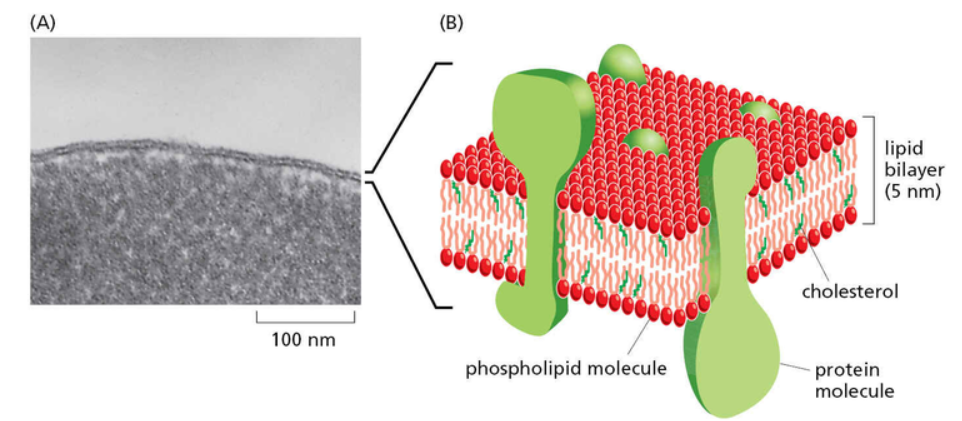
Almost all biological membranes share the same common structure: that of a thin, fluid film of lipid and protein molecules. I will not touch on the role of these specialized membrane proteins, however I will note that they account for about 30% of all of the proteins encoded for in an animal’s genome. Hence, one can imagine the central role they play in mediating membrane processes and as a result what a rich topic of study they form. For that matter, it is worth declaring that we will in general be considering large scale behaviour and how, in this limit, to describe membranes mathematically. Thus, a great deal of that what has been uncovered about local chemical and physical processes will be skipped here (an introduction may be found here).
Lipid molecules are amphiphilic, meaning that they have one hydrophilic end (the head) and one hydrophobic end (the tail). The molecules aggregate and due to a free energy pertaining to the lipid-water interface, spontaneously assemble into bilayer, fluid films approximately 5nm thick (see below illustration*). Notably, lipid membranes are able to stably span lateral distances several orders of magnitude greater than their width and many of their characteristic energies are an order of magnitude greater than the thermal energy. Therefore, they are stable against thermal fluctuations and yet soft enough to be deformable by proteins using energies produced biochemically (i.e. by ATP hydrolysis).
I finish this brief introduction with the following remark, that in lipid bilayers the area per lipid is a remarkably stiff degree of freedom, that is to say that membranes are hard to stretch but easy to bend. This observation shall be important in that it allows us to define a purely geometric Hamiltonian and motivates the following section in which I will introduce a set of elegant mathematical tools which are well suited to the study of membranes: those of Differential Geometry.